Recording Your Own Audiobook – What Should You Consider?
Creating your own audiobook has become easier than ever: production and distribution costs have steadily decreased, while the processes involved have become simpler. This makes the audiobook market particularly attractive for new authors and self-publishers.

Chris Kling
Copied to clipboard!
Audiobooks are an exciting format that has become increasingly popular over the years, particularly in Germany. They offer stable sales potential and provide an opportunity to increase your own visibility by reaching audiobook listeners as well.
In Germany, audiobooks are especially popular in children’s and young adult literature and fiction, closely followed by the educational segment, including guides and nonfiction books.
Statistics show that authors of guides and coaches in particular can expect consistent demand in this segment. With average annual revenue of around €80 million in Germany alone, the audiobook market is by no means a niche phenomenon.
At the same time, the share of self-publishers in this market continues to grow. Because entering the market without previous publishing experience has become considerably easier and more affordable, there is increasingly little reason not to give it a try.
Below, we would like to share some of the experience we have gained in this area.
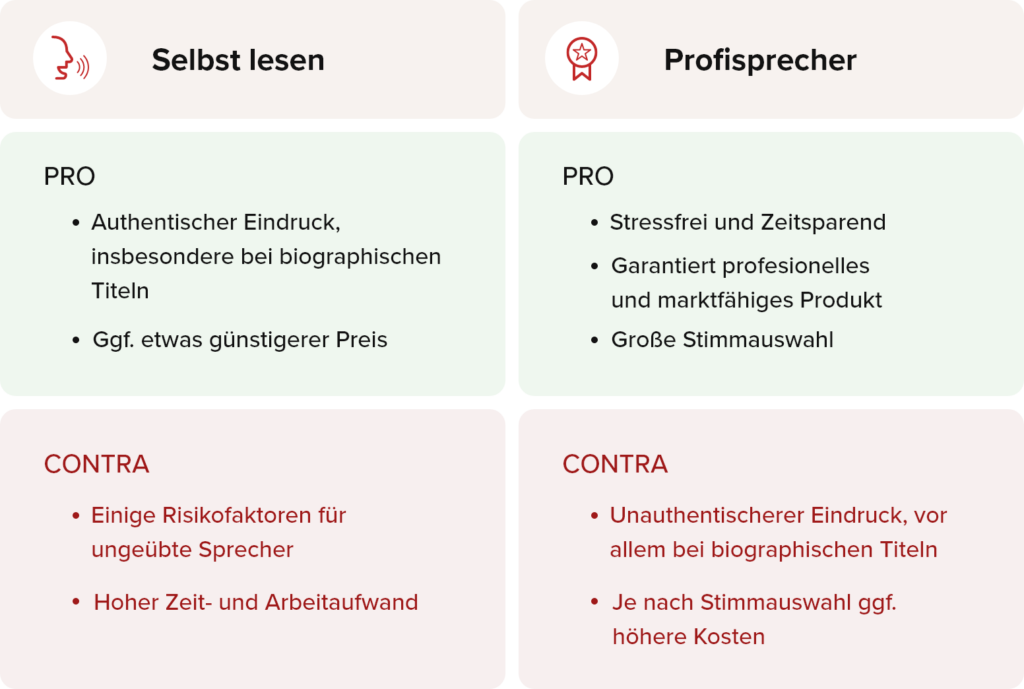
Should I narrate it myself or hire a professional narrator?
This is often one of the very first questions for self-publishers and new authors.
There are good reasons for both approaches, and they should be carefully weighed against one another.
Many production companies immediately recommend working with professional narrators because the production process can be more routine and efficient.
However, in some cases it is worth taking a closer look.
With autobiographical works, as well as educational, self-help and coaching titles, the content is often closely connected to the author’s personality. In these cases, hearing the author themselves can create a significantly more authentic impression than even a perfectly trained professional voice.
That said, working with a professional narrator is incredibly convenient.
All you need to do is select the voice, provide a few comments and direction notes, and the audiobook can go into production.
Even though the narrator receives a fee, the time saved in the studio by working with a professional means that the overall production cost is often comparable to an author-narrated production — and in some cases, it can even be lower.
For audiobook inquiries, we provide a selection page where you can choose your preferred voice from existing samples across a range of price points.
Working with a professional narrator, combined with competent production preparation, is incredibly convenient — and often not even more expensive than narrating the book yourself. Thanks to the time saved, it can sometimes even be cheaper.
One thing should also be clear: speaking professionally is a skill that needs to be learned.
If your first thought is, “Well, I can speak, so I should be able to do this myself,” some caution is advisable.
Professional narrators do not spend years training and developing experience for no reason.
Articulation, subtle regional accents, vocal endurance, the ability to shape and interpret text, concentration and many other factors can quickly become challenges for an inexperienced narrator in a studio environment.
Both approaches have clear advantages and disadvantages, and much depends on the individual work.
We do not want to discourage anyone from narrating their own book, but rather create awareness of the potential challenges.
On average, a lot can still be achieved even from a recording that is not completely fluent.
Experienced public speakers also tend to have excellent foundations for microphone work.
For this reason, it is worth carefully weighing these factors and doing a longer test read at home — ideally recording it with your smartphone so that you can get at least a rough impression of how the finished product might sound.
Can I record my audiobook myself in a home studio?
Today, the cost of entering the audio market is significantly lower than it once was.
And to be fair, producing a voice recording is not something that necessarily requires years of audio engineering training.
But it is a little like preparing a good meal: with a few carefully selected, high-quality ingredients and one or two well-timed steps, the process becomes much easier and the result is far more likely to succeed.
The first ingredient is your voice.
If your voice, interpretation and reading performance are convincing, you are already at least halfway there.
If someone simply reads through a text monotonously without tension or variation, listeners will quickly lose interest — even if the recording itself is technically flawless.
What matters is the interaction between vocal quality, comfort and technical infrastructure.
The second factor is the technical setup, for two main reasons.
First, you need to feel confident and comfortable while narrating.
If the technology is unreliable, you are uncertain about how to operate it, or technical problems and other distractions constantly interrupt you, it becomes much harder to focus calmly on your performance.
Second, the interaction between room acoustics, microphone and DAW plays a major role.
With audiobooks in particular, a poorly isolated or acoustically untreated room can create an unpleasant sense of space in the recording — especially in small, square rooms.
After one or two hours, this can make listening subtly exhausting even if the audience cannot immediately identify why.
Audio equipment has become very affordable. Nevertheless, the interaction between factors such as workflow, room acoustics and mastering should not be underestimated when recording an audiobook — alongside elements such as direction and correction rounds.
The same applies to background noise, noise levels and generally unpleasant sound caused by microphone choice or positioning.
This is also why we designed our studios specifically for optimal voice recording.
We have found that this significantly reduces production time while also improving overall quality.
The conclusion: it is absolutely possible today to produce acceptable voice recordings in a home studio.
However, the initial investment in equipment, the time required to learn the technology and the acoustic treatment of the room only really become economical if you plan to produce content regularly.
How much will the audiobook cost?
This depends primarily on how much production time is required.
The first relevant factor is the length of the audiobook.
The most useful measurement for us is the number of characters in the manuscript, including spaces.
From this, we can estimate the runtime of the final audio production.
Length, voice selection and the script all influence the price.
If you plan to narrate the audiobook yourself, the cost depends on how much time you need to record the script.
As a conservative initial estimate, it makes sense to assume that one hour of finished material will require around two to three hours of studio recording time.
If you get through it faster, even better.
A professional narrator will generally work more quickly because they are less likely to need repeated takes.
This has a positive effect both on recording time and on the amount of editing and post-production required afterward.
If you would like more detailed information about pricing and production costs, we have put together a separate article on this topic.
How can I distribute my audiobook?
It is no longer news that revenue from physical products has declined significantly in both the music and audiobook industries, with these formats increasingly becoming a niche.
Audiobooks as downloads and, increasingly, direct streams have become much more relevant and have entered the mass market.
Leading the way is Amazon with its audiobook brand Audible, which remains the market leader.
Spotify, which has already established a dominant position in music streaming, is also becoming increasingly important for audiobook distribution.
Other providers such as Apple, Deezer, Thalia and Google are also active in this market.
Downloads and streaming have replaced CDs — although physical editions can still make sense in certain cases.
It should therefore be considered essential to make an audiobook available through all relevant download and streaming platforms.
Many audiobook listeners will already have a subscription with one particular provider and may not be willing to spend additional money with another service just to access a single title.
There are now numerous distributors that handle delivery to all major stores and manage digital audiobook distribution.
Their pricing structures and processes vary slightly.
Some, such as Bookwire, are primarily aimed at publishers and offer very extensive functionality, while others provide simpler solutions for self-publishers.
For audiobooks produced with us, we also offer straightforward digital distribution at very favorable terms.
We guide clients through the entire process and handle the administrative formalities on their behalf.
Making your audiobook available through all relevant download and streaming platforms should be considered essential.
In some cases, however, it can still make sense to offer a physical CD edition as well.
Without the support of a major publisher and substantial promotion, the relatively small retail margin will rarely be enough to cover the costs of producing CDs.
However, physical products can still make sense for authors who expect to generate meaningful revenue through direct sales.
An established website with an online shop can help, but tours, reading events and workshops — particularly in educational and coaching contexts — are especially good opportunities where a market for physical products still exists.
Interested in producing an audiobook with us?
We would be happy to advise you, guide you through the process, and support you beyond production with distribution and marketing.

